




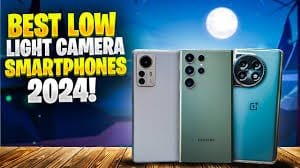
The single most challenging frontier in smartphone photography is low-light performance. It is the true test of a camera system, pushing hardware (sensor size, aperture) and software (computational photography, $AI$) to their absolute limits. In $2025$, the competition for the low-light crown is tighter and more advanced than ever before, dominated by three titans: the Google Pixel 10 Pro, the Apple iPhone 17 Pro Max, and the Samsung Galaxy S26 Ultra.
These devices no longer just “take pictures in the dark”; they use sophisticated technology to synthesize light, eliminate noise, preserve dynamic range, and render colors accurately in near-pitch black conditions. Choosing the “best” depends entirely on the photographer’s priority: do you value maximum detail, color accuracy, or sheer versatility?
This comprehensive deep dive pits the three $2025$ flagships against each other, examining the critical hardware specifications and the proprietary software magic that determines who stays current when the sun goes down.
1. The Low-Light Trinity: Hardware vs. Software
The performance in dim environments relies on a delicate balance of three key components, where each phone has chosen a different emphasis.
A. Google Pixel 10 Pro: The Computational King
Google’s philosophy has always been clear: Software beats hardware. The Pixel 10 Pro continues to rely heavily on its proprietary silicon (the Tensor G5) and the resulting $AI$ power to achieve its low-light superiority.
- Strength: Night Sight and $AI$ Fusion: The Pixel’s famed Night Sight mode is less about extending exposure and more about intelligently fusing multiple frames, using machine learning to discern texture from noise.
- Low-Light Signature: Pixel photos are typically brighter, with shadows lifted significantly to reveal hidden details. The color accuracy is often superior, especially with human skin tones, avoiding the overly warm or yellow casts that affect rivals. Its Camera Coach ($AI$ feature) guides users to optimal settings, making great night shots effortless.
- The Trade-Off: While noise is low, the image can sometimes look slightly “synthetic” or over-sharpened when pixel-peeping due to the aggressive $AI$ processing.
B. Apple iPhone 17 Pro Max: Consistency and Video Dominance
The iPhone $17$ Pro Max represents the peak of balanced performance and reliability. Apple prioritizes a natural look and superior video capture.
- Strength: Photonic Engine and ProRAW: The Photonic Engine performs Deep Fusion and Smart HDR earlier in the image pipeline, before compression, retaining more data and leading to exceptionally clean images. The new $48\text{MP}$ sensors across all lenses improve light gathering across the board.
- Low-Light Signature: iPhone images tend to be closer to what the eye sees—moodier, with deeper blacks, but outstanding detail and consistency across all three lenses ($0.5\times, 1\times, 4\times$). Its strength lies in its low-light video, where ProRes RAW video capture offers filmmakers unprecedented dynamic range and color flexibility in challenging scenes.
- The Trade-Off: The iPhone’s default output is often slightly less bright than the Pixel or Samsung, and its noise reduction can sometimes smooth over fine textures.
C. Samsung Galaxy S26 Ultra: Sensor Size and Aperture Aggression
Samsung’s approach in $2025$ with the S26 Ultra is to combine brute-force hardware with advanced computational layering.
- Strength: Wide Aperture and $200\text{MP}$ Sensor: The S26 Ultra is rumored to feature an upgraded main sensor with a massive $f/1.4$ aperture (up from $f/1.7$ in previous generations). This wider opening allows significantly more physical light to hit the $200\text{MP}$ sensor, a fundamental advantage over its rivals.
- Low-Light Signature: The S26 Ultra excels at multi-frame noise reduction, producing images that are stunningly detailed, particularly in the mid-tones. Samsung’s images are typically the most “vivid,” featuring highly saturated colors and dramatic contrast, which is popular for social media sharing.
- The Trade-Off: The aggressive color processing and sharpening can sometimes lead to oversaturated or unrealistic colors, known as the “Samsung Look.” The large sensor and wide aperture can also result in a narrower depth of field, occasionally making group shots slightly out of focus in the background.
2. The Low-Light Specification Deep Dive
The devil is in the details of the camera array. Here is a comparison of the critical hardware specs that drive low-light performance:
| Specification | Google Pixel 10 Pro | Apple iPhone 17 Pro Max | Samsung Galaxy S26 Ultra |
| Main Sensor Size (Estimate) | $\sim 1/1.3$ inches | $\sim 1/1.28$ inches | $\sim 1/1.3$ inches (w/ $f/1.4$ Aperture) |
| Main Camera Resolution | $50\text{MP}$ | $48\text{MP}$ | $200\text{MP}$ |
| Main Camera Aperture | $f/1.68$ | $f/1.78$ | $f/1.4$ (Largest opening) |
| Primary Zoom (Optical) | $5\times$ Telephoto ($113\text{mm}$) | $4\times$ Telephoto ($100\text{mm}$) | $5\times$ Super Telephoto ($111\text{mm}$) |
| Low-Light Zoom Performance | Best at $5\times$ due to $AI$ processing (Pro Res Zoom). | Excellent up to $4\times$ (new $48\text{MP}$ sensor). | Best overall zoom reach with $5\times$ optical and high-res sensor. |
| Computational $AI$ | Tensor G5 / Night Sight | Photonic Engine / Deep Fusion | AI ProVisual Engine |
The Aperture Advantage
The S26 Ultra’s rumored $f/1.4$ aperture is a significant hardware win. Aperture is the opening that lets light in; a smaller number means a wider opening. The leap from $f/1.7$ to $f/1.4$ represents a huge gain in light-gathering ability, reducing the reliance on slower shutter speeds and $AI$ fusion, which is crucial for sharp photos of moving subjects at night.
The Sensor and Pixel Binning
The S26 Ultra’s $200\text{MP}$ sensor uses pixel binning (combining $16$ pixels into $1$) to create a massive effective pixel size ($\sim 2.56 \mu\text{m}$). This is a physical method of gathering light that is exceptionally effective in dark scenes. The Pixel and iPhone use $4$-in-$1$ binning, which is also superb but relies more on software magic.
3. Real-World Scenarios: Where Each Phone Excels
The best phone depends on the type of low-light photography you do most often.
A. Street Photography and Portraits (Winner: Google Pixel 10 Pro)
When capturing people or fleeting moments in complex, mixed-lighting environments (like a neon-lit street or a restaurant), the Pixel’s computational focus on color accuracy and portrait integrity is unparalleled.
- Accurate Skin Tones: The Pixel’s $AI$ algorithms are trained to recognize and prioritize natural skin tones, avoiding the overly-yellow or reddish casts that other phones produce in incandescent or sodium-vapor light.
- Instant Capture: Night Sight is now virtually instantaneous, minimizing the chance of motion blur when photographing a person or a moving car.
- Portrait Mode: The Pixel 10 Pro’s Portrait Mode in low light offers the most natural-looking bokeh and edge detection, thanks to its powerful Tensor chip.
B. Low-Light Video and Consistency (Winner: Apple iPhone 17 Pro Max)
If your primary need is capturing high-quality video in low-light environments (concerts, late-night events) or maintaining a consistent color profile across all lenses, the iPhone $17$ Pro Max is the clear choice.
- Video Boost: While the Pixel offers Video Boost for post-processing, the iPhone’s real-time video performance, especially in ProRes RAW format, offers cleaner, more stable footage with less grain and superior rolling shutter control.
- Lens Matching: Apple’s color science and processing are calibrated to ensure the ultra-wide, main, and telephoto cameras produce images with nearly identical color and white balance, even at night—a huge advantage for photographers who rely on versatility.
C. Low-Light Zoom and Far-Field Detail (Winner: Samsung Galaxy S26 Ultra)
For the user who needs to capture distant subjects at night (like architectural details, wildlife, or signage), Samsung’s hardware commitment wins out.
- Optical Zoom Advantage: The S26 Ultra’s $5\times$ optical telephoto is paired with a high-resolution sensor, and its $AI$ enhances this zoom range further. While the Pixel’s Pro Res Zoom is powerful, the Samsung starts with superior optical data.
- Scene Segmentation: Samsung’s $AI$ ProVisual Engine is adept at recognizing distant objects (the moon, buildings) and applying targeted noise reduction and sharpening, leading to far-field shots that often look astonishingly detailed for a mobile phone.
Conclusion: The Photographer’s Final Choice
The low-light battle of $2025$ is a technical marvel, with no true “bad” camera among these flagships. The decision is highly personal and driven by usage:
- For the Purist & Photo Journalist (Pixel 10 Pro): Choose the Pixel if your priority is accurate color rendition, superb portraiture, and effortless point-and-shoot reliability. The Pixel’s $AI$ is the best safety net in photography.
- For the Content Creator & Filmmaker (iPhone 17 Pro Max): Choose the iPhone if low-light video quality, lens-to-lens consistency, and a more natural, film-like aesthetic are your goals. The seamless professional video workflow is its undisputed strength.
- For the Specification Hunter & Zoom Enthusiast (Samsung Galaxy S26 Ultra): Choose the Samsung if you demand maximum versatility, the widest aperture, and best-in-class zoom capability, accepting a trade-off for its signature vibrant (sometimes hyper-real) color processing.
The Samsung Galaxy S26 Ultra, with its rumored $f/1.4$ aperture and $200\text{MP}$ sensor, arguably possesses the single most powerful low-light hardware foundation. However, the Google Pixel 10 Pro retains the title for most consistent and aesthetically pleasing low-light stills due to its superior computational intelligence.
Which of these three titans would you trust when the lights go out?
Discover more from Mobihub Electronics Kenya
Subscribe to get the latest posts sent to your email.


