




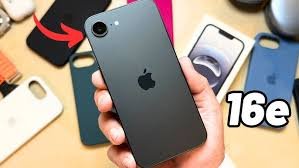
The launch of the iPhone 16e at the start of the 2025 cycle marked a pivotal shift in Apple’s strategy for the entry-level smartphone market. Moving away from the long-standing, compact, and highly specific $\text{SE}$ (Special Edition) form factor, the $\mathbf{16\text{e}}$ instead positions itself as the Economical or Essential tier of the flagship $\mathbf{16}$ line. It is a full-sized, $\mathbf{6.1\text{-inch}}$ device engineered to deliver the non-negotiable modern $\text{iPhone}$ experience—namely, the $\mathbf{A18}$ chip and $\text{Apple \text{ Intelligence}$—at the lowest possible price point (Source 1.2, 3.3).
Starting at $\mathbf{\$599}$, the $\mathbf{16\text{e}}$ sits $\mathbf{\$100}$ below the standard $\mathbf{16}$ model, an aggressive pricing strategy designed to compete with high-end Android devices while retaining Apple’s premium core. However, achieving this price reduction required Apple to make meticulous, calculated sacrifices in hardware and features. The $\mathbf{16\text{e}}$ is defined by what it retains—power and battery life—and what it omits—the premium conveniences and creative tools found in its pricier siblings.
Mobihub delivers the definitive breakdown of the $\mathbf{16\text{e}}$’s specifications, revealing the key trade-offs and helping you determine if the budget $\text{iPhone}$ truly offers the best value, or if the $\mathbf{16}$’s extra features are worth the investment.
1. 🖼️ The Display: Trading Fluidity and Brightness for Cost
The display is the most immediate area where the $\mathbf{16\text{e}}$ diverges from the rest of the $\mathbf{16}$ lineup. While still a high-quality $\text{OLED}$ panel, Apple has opted for older, cheaper technology components.
1.1. The Return of the Notch
The $\mathbf{16\text{e}}$ reintroduces the $\text{U-shaped}$ notch design, familiar from the $\text{iPhone 14}$ generation, in place of the contemporary $\text{Dynamic Island}$ (Source 1.2, 2.3).
- Aesthetics vs. Functionality: The $\text{Dynamic Island}$ on the standard $\mathbf{16}$ model elegantly morphs to show alerts, music controls, and background activities, offering a clever software integration that enhances the user experience. The $\mathbf{16\text{e}}$’s notch performs the same core function—housing the $\text{TrueDepth}$ camera for $\text{Face \text{ ID}$ and the selfie camera—but lacks any of this interactive, animated software integration (Source 2.3, 3.2). This design choice is a clear cost-saving measure, utilizing a less complex panel structure.
1.2. The $\mathbf{60\text{Hz}}$ Limitation
The $\mathbf{16\text{e}}$ uses a $\mathbf{6.1\text{-inch}}$ $\text{Super \text{ Retina \text{ XDR \text{ OLED}}}$ display with a resolution of $2532 \times 1170$ pixels ($\mathbf{460 \text{ ppi}}$) (Source 1.3, 4.4). However, it is restricted to a $\mathbf{60\text{Hz}}$ refresh rate (Source 4.2, 4.4).
- No $\text{ProMotion}$: This is the most significant visual sacrifice. The $\mathbf{16\text{e}}$ lacks $\text{ProMotion}$ technology, which allows the standard $\mathbf{16}$ and Pro models to scale up to $\mathbf{120\text{Hz}}$ (Source 2.1). The result is that scrolling, swiping, and gaming are less fluid and responsive compared to a $\mathbf{120\text{Hz}}$ device. While $\mathbf{60\text{Hz}}$ is perfectly usable, it places the $\mathbf{16\text{e}}$ behind many budget-midrange Android competitors that now routinely feature $\mathbf{90\text{Hz}}$ or $\mathbf{120\text{Hz}}$ screens.
- Brightness Trade-off: The panel is also dimmer than the standard $\mathbf{16}$. The $\mathbf{16\text{e}}$ offers $\mathbf{800}$ nits of typical brightness and peaks at $\mathbf{1200}$ nits in $\text{HDR}$ (Source 1.3, 4.2). The standard $\mathbf{16}$ boasts a higher typical brightness and a peak of $\mathbf{1700}$ to $\mathbf{2000}$ nits (Source 2.1, 4.2). This difference is critical for users who spend a lot of time viewing the screen outdoors in bright sunlight.
2. 📷 The Camera System: Loss of Creative Versatility
The $\mathbf{16\text{e}}$ ensures high image quality for the average user, but it deliberately strips away the lenses and software features that appeal to advanced photographers and videographers.
2.1. The Single $\mathbf{48\text{MP}}$ Fusion Camera
The $\mathbf{16\text{e}}$ relies on a single $\mathbf{48\text{MP}}$ $\text{Fusion \text{ Main}$ camera (Source 1.3, 2.3). This sensor is powerful and features $\mathbf{f/1.6}$ aperture, $\text{OIS}$, $\text{Photonic \text{ Engine}$, and advanced computational photography (Source 1.3, 3.4).
- Retained Quality: Due to pixel-binning, the $\mathbf{16\text{e}}$ produces excellent $\mathbf{24\text{MP}}$ default images and can capture super-high-resolution $\mathbf{48\text{MP}}$ shots (Source 1.3). It also retains an optical-quality $\mathbf{2\times}$ $\text{Telephoto}$ option by cropping the high-resolution sensor (Source 1.3, 2.3).
- The Missing Lens: The crucial sacrifice here is the omission of the $\mathbf{12\text{MP}}$ $\text{Ultra \text{ Wide}$ lens (Source 2.1, 2.3). This means the $\mathbf{16\text{e}}$ cannot capture wide $\mathbf{0.5\times}$ landscape or architectural shots. For many users, the $\text{Ultra \text{ Wide}$ lens is essential for versatility.
- Missing Features: The lack of the $\text{Ultra \text{ Wide}$ camera also eliminates other key functionalities found on the standard $\mathbf{16}$, including $\text{Macro \text{ Photography}}$ and the ability to record $\text{Spatial \text{ Videos}}$ for the $\text{Apple \text{ Vision \text{ Pro}$ (Source 2.1). Furthermore, the $\mathbf{16\text{e}}$’s portrait mode is restricted, unable to automatically recognize and apply the depth effect to non-human subjects (Source 2.2).
2.2. Video and Control Limitations
The $\mathbf{16\text{e}}$’s video capabilities, while still impressive at $\mathbf{4K60}$ $\text{Dolby \text{ Vision}$, are constrained compared to the standard model (Source 1.3, 4.3).
- No $\text{Cinematic \text{ Mode}}$ $\mathbf{4K}$: The standard $\mathbf{16}$ offers $\text{Cinematic \text{ Mode}$ video recording at $\mathbf{4K30}$, allowing for powerful focus and depth control in post-production. The $\mathbf{16\text{e}}$ lacks this advanced $\mathbf{4K}$ capability (Source 2.1).
- No $\text{Action \text{ Mode}$ or $\text{ProRes}$: The $\mathbf{16\text{e}}$ also omits $\text{Action \text{ Mode}$ (for super-smooth, stabilized action footage) and the professional $\text{ProRes}$ video format (Source 2.1, 2.2). The $\mathbf{16\text{e}}$ also lacks the $\text{Camera \text{ Control \text{ Button}}$ found on its higher-tier siblings (Source 2.3, 3.3).
3. 🔌 Connectivity and Ecosystem Restrictions
Some of the most frustrating compromises for existing $\text{iPhone}$ power users are in the core connectivity and charging standards—features that affect daily convenience and the accessory ecosystem.
3.1. The Omission of $\text{MagSafe}$
In a clear bid to save on component costs and distinguish the lower tier, the $\mathbf{16\text{e}}$ does not feature $\text{MagSafe}$ technology (Source 1.2, 5.2).
- Slower Wireless Charging: The $\mathbf{16\text{e}}$ is limited to the older $\mathbf{7.5\text{W}}$ $\text{Qi}$ wireless charging standard (Source 1.3, 5.2). This is significantly slower than the standard $\mathbf{16}$’s $\mathbf{15\text{W}}$ $\text{MagSafe}$ or the $\mathbf{25\text{W}}$ $\text{MagSafe}$ speeds achieved with the newest chargers and the base $\mathbf{16}$ model (Source 5.1, 5.2). Wireless charging on the $\mathbf{16\text{e}}$ is relegated to an overnight convenience rather than a rapid top-up.
- Loss of Ecosystem: The lack of the internal magnetic ring means the $\mathbf{16\text{e}}$ cannot natively use the vast $\text{MagSafe}$ accessory ecosystem: the magnetic wallets, car mounts, stands, and battery packs (Source 5.3). While third-party magnetic cases can restore the magnetic alignment for accessories, they cannot restore the faster $\text{MagSafe}$ charging speeds (Source 5.1, 5.3).
3.2. Limited Data Speeds
The $\mathbf{16\text{e}}$ finally adopts the $\text{USB-C}$ port, aligning with the rest of the industry (Source 1.3, 3.3). However, the port is restricted to $\text{USB 2.0}$ data transfer speeds (up to $\mathbf{480 \text{ Mb/s}}$) (Source 4.4, 5.4).
- Transfer Bottleneck: This is a non-issue for charging, which peaks at $\mathbf{25\text{W}}$ wired (Source 5.4), but it creates a significant bottleneck for transferring large $\mathbf{4K}$ video files or high-resolution $\mathbf{48\text{MP}}$ $\text{HEIF}$/$\text{JPEG}$ photos to a computer. The standard $\mathbf{16}$ model supports the faster $\text{USB 3}$ standard.
- Connectivity Downgrades: The $\mathbf{16\text{e}}$ uses the efficient $\text{Apple \text{ C1}$ $\text{cellular \text{ modem}$ for $\mathbf{5\text{G}}$ but lacks $\text{mmWave}$ $\mathbf{5\text{G}}$ support and is limited to $\text{Wi-Fi 6}$ (Source 1.2, 2.1, 4.1). While $\text{mmWave}$ is rare, its absence means the $\mathbf{16\text{e}}$ cannot access the absolute fastest $\mathbf{5\text{G}}$ speeds available in densely populated areas.
4. 💪 The Uncompromised Core: The $\mathbf{A18}$ and $\text{AI}$ Parity
The $\mathbf{16\text{e}}$’s greatest success is that it makes no sacrifices on the two components that matter most for long-term ownership: the processor and the battery life.
4.1. Full $\text{Apple \text{ Intelligence}}$ Support
The $\mathbf{16\text{e}}$ is powered by the $\mathbf{A18}$ chip, the same base processor found in the standard $\mathbf{16}$ model (Source 1.2, 4.1). While the $\mathbf{16\text{e}}$’s $\mathbf{A18}$ features a slightly down-specced $\mathbf{4\text{-core}}$ $\text{GPU}$ compared to the $\mathbf{16}$’s $\mathbf{5\text{-core}}$ $\text{GPU}$ (Source 2.1, 4.4), the core performance is nearly identical for everyday tasks.
- $\text{AI}$ Revolution: Crucially, the $\mathbf{16\text{e}}$ is fully equipped with the $\mathbf{16\text{-core}}$ $\text{Neural \text{ Engine}$ required to run all features of $\text{Apple \text{ Intelligence}$ (Source 1.2, 4.1). This means the most affordable $\text{iPhone}$ in the current generation provides the same advanced on-device generative $\text{AI}$ features—such as enhanced $\text{Siri}$, system-wide writing tools, $\text{Genmoji}$, and complex photo editing—as the $\mathbf{16 \text{ Pro \text{ Max}$ (Source 1.2). This $\text{AI}$ capability is the definition of future-proofing.
4.2. Best-in-Class Battery Life
The $\mathbf{16\text{e}}$ shines brightest in endurance, a feature that often matters more to mainstream users than $\mathbf{120\text{Hz}}$ scrolling. Thanks to its larger $\mathbf{4005 \text{mAh}}$ battery (Source 4.2, 4.4)—bigger than the standard $\mathbf{16}$’s $\mathbf{3561 \text{mAh}}$ cell—and the highly efficient $\mathbf{C1}$ modem, the $\mathbf{16\text{e}}$ delivers the longest battery life of any $\mathbf{6.1\text{-inch}}$ $\text{iPhone}$ (Source 1.4, 3.3).
- Exceptional Endurance: Apple officially rates the $\mathbf{16\text{e}}$ for up to $\mathbf{26}$ hours of video playback (Source 1.3, 4.3). Independent tests confirm this extended endurance, often surpassing the standard $\mathbf{16}$ by several hours (Source 4.2). The $\mathbf{16\text{e}}$ is the ultimate choice for users prioritizing all-day, worry-free power.
4.3. Premium Design and Durability
Despite its budget price, the $\mathbf{16\text{e}}$ doesn’t look or feel cheap. It retains the same aerospace-grade aluminum frame, $\text{Ceramic \text{ Shield}$ front cover, and an industry-leading $\text{IP68}$ water and dust resistance rating (Source 1.2, 1.4, 3.4). Crucially, it also includes the customizable $\text{Action \text{ Button}$ (Source 1.2, 3.3), a feature that previously debuted on the Pro models and is a major win for the $\mathbf{16\text{e}}$ user.
5. 💰 The Value Equation: Is the ‘e’ Worth the Savings?
The ‘e’ in $\text{iPhone 16e}$ should stand for Excellence in Essentials. It maintains the $\mathbf{A18}$ chip, full $\text{Apple \text{ Intelligence}$ support, a premium $\text{OLED}$ screen, a stellar main camera, and exceptional battery life. The sacrifices are mainly on premium conveniences:
| Feature Sacrificed on 16e | Impact on User Experience | Who Is Affected Most? |
|---|---|---|
| No $\text{ProMotion}$ ($\mathbf{60\text{Hz}}$ Only) | Slower, less fluid scrolling/gaming. | Users upgrading from $\mathbf{120\text{Hz}}$ phones and avid mobile gamers. |
| No $\text{Ultra \text{ Wide}$ Camera | Limits creative versatility (no landscapes, macro). | Photographers, creators who need a wide field of view. |
| No $\text{MagSafe}$ ($\mathbf{7.5\text{W}}$ $\text{Qi}$ Only) | Slower wireless charging; no magnetic accessories. | Power users who rely on the $\text{MagSafe}$ ecosystem for charging and accessories. |
| $\text{USB 2.0}$ Data Speed | Slow file transfer via USB-C cable to PC/Mac. | Videographers or heavy photo shooters who frequently offload large files. |
| No $\text{Dynamic Island}$ (Notch) | Less modern aesthetic; loss of animated software hub. | Users prioritizing the latest look and feel. |
For the average consumer upgrading from an $\text{iPhone \text{ 11}$ or older $\text{SE}$ model, the $\mathbf{16\text{e}}$ represents a monumental leap forward in every category—performance, camera, and battery life—at a highly attractive price. The features it omits are luxury additions that most users can live without.
The $\mathbf{16\text{e}}$ is the smarter financial choice for $\mathbf{90\%}$ of the market. The $\mathbf{\$100}$ saved allows budget-conscious buyers to access the core $\text{Apple \text{ Intelligence}$ ecosystem, ensuring their new $\text{iPhone}$ remains fast and relevant for years to come. The $\mathbf{16\text{e}}$ is the essential $\text{iPhone}$ experience, uncompromised where it truly matters.
Discover more from Mobihub Electronics Kenya
Subscribe to get the latest posts sent to your email.


